Siân Edwards steps into the eye of the storm of ever-faster trend cycles
| The big idea:
· Trend cycles are speeding up, driven by algorithms, micro-communities and the globalization of tastes. · To compete, brands and operators should pair a clear core proposition with selective innovation that feels authentic and intentional. · Winners will balance consistency with agility, using low-risk experimentation to move quickly, without overcommitting. |
The pace of change in food and beverage has never been faster. What was once a predictable cycle of emergence, adoption and mass scale has fragmented into something far more volatile: a constant stream of micro-trends, driven by algorithms and amplified by a global, hyper-connected audience.
Trends no longer build steadily over time. They spike, scale and fade, sometimes in a matter of weeks. For beverage brands and foodservice operators, this creates a complex challenge – how to keep pace and stay relevant without losing focus or overextending.
Speed and proliferation
We’re seeing two fundamental shifts – the first being speed. Where trends once took years to move from niche to mainstream, many now complete the full cycle from discovery to saturation in a fraction of that time. Alongside this, there is far greater proliferation of trends. Rather than a small number of dominant and distinct dynamics shaping the category, brands are now navigating dozens of overlapping, short-lived signals.
This is particularly visible in menu innovation cycles. Technomic data highlights the growing use of Limited Time Offers (LTOs) as a way to innovate quickly, access multiple trends and keep menus fresh. In 2025, US foodservice featured 41,707 LTO items, up 13% vs. 2024, and 2.5 times higher than 2019, when just 16,187 were recorded [Technomic, 2026]. This trend is most pronounced in cold non-alcoholic beverages, now the leading category for LTO activity

What’s driving these shifts?
Four structural forces are underpinning this acceleration and proliferation
- Algorithmic amplification: Digital platforms are designed to prioritize newness, and constantly surface emerging content. This creates a self-reinforcing loop, in which novelty is rewarded, shrinking the window of relevance for trends, and pushing consumers onto the next thing.
- Rise of micro-communities: Trends have always started in niche groups, but today these communities are more influential and far-reaching. Highly engaged and globally connected, they can propel ideas into the mainstream at speed, resulting in faster breakout moments and multiple trends running in parallel, rather than one dominant wave.
- Globalization of taste: Ideas now move instantly and seamlessly between markets. Flavors, formats and concepts that once spread gradually – dependent on international travel – now scale internationally within days, accelerating both adoption and saturation.
- Consumer preferences: Younger consumers are increasingly drawn to innovation and more “experiential” drinks, where beverages act as both a form of self-expression and an affordable indulgence (a new kind of “lipstick effect”). This is fueling demand for constant NPD. In a 2025 survey, 53% of US consumers said LTO availability influences their restaurant choice, a figure that has steadily increased over time [Technomic, 2026].
The key takeaway is that brands are no longer participating in a single trend cycle – they are operating within a complex ecosystem of simultaneous, fast-moving signals, selling to consumers who have grown up with greater exposure and access to products than ever before.

“If you feel it, chase it”
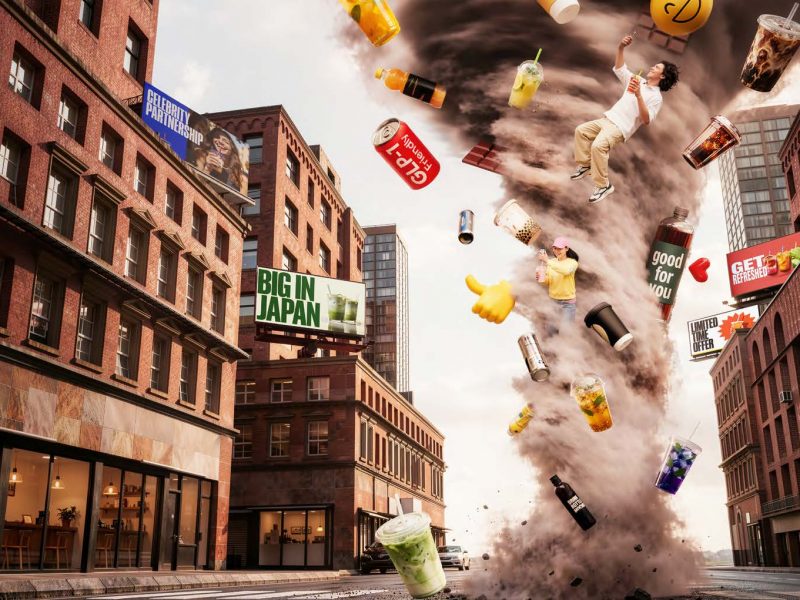
For brands wondering whether to batten down the hatches or step into the trend-nado, the reality is you need to do both.
A strong core proposition keeps you grounded. It builds loyalty, drives repeat purchase, and protects you from the volatility of chasing every passing trend. But playing it too safe comes at a cost. You risk missing the upside of a trend in motion: unlocking growth, reaching new consumers, or staying culturally relevant.
The brands that get this balance right are deliberate. Take Milo’s: a crystal-clear proposition built around home-brewed Southern tea, paired with selective, thoughtful innovation. New products, such as fruit punch flavours, lean into the brand’s nostalgic roots while staying true to its fundamentals: 100% natural ingredients, no preservatives, no shortcuts. Nothing feels forced, and nothing compromises what made the brand successful in the first place.

So how do you strike that balance? Here’s our playbook:
- Be clear about your core. Know exactly what you stand for, who your consumers are, and why they keep coming back. If you can’t articulate that cleanly, you’ll struggle to make the right calls on what to chase and what to ignore.
- Make authenticity tangible. Increasingly, this is coming through people – founders, product teams, the faces behind the brand. Done well, it builds trust and cuts through the noise. M&S in the UK is a great example, with Kathryn Turner bringing product launches to life, sharing the inspiration behind them and showcasing the teams involved. It creates a sense of connection that goes beyond the product itself.
- Be intentional with innovation. Not every trend is worth your time. The key is knowing which ones fit, where they genuinely add something to your portfolio, reinforce your positioning, or meet a real consumer need. Everything else is distraction.
- Look outside of your core categories. Take inspiration from trends in food and beyond. Desserts are an obvious crossover, think cookie dough or brownie flavours in iced coffee, but increasingly, beverages are borrowing from non-food spaces like beauty, where visual identity, functionality, and ritual have long set the standard.
- Build a system that can move at pace. It’s not just about having good ideas, it’s also about being able to act on them quickly and learn fast. That means shorter cycles, clearer decision-making, and tracking more than just sales: speed to market, test-and-learn effectiveness, repeatability, and brand impact all matter.
- Use low-risk ways to experiment.
Limited-time offers and seasonal launches are a smart way in. They let you test, learn, and create excitement without overcommitting. After all, the pumpkin spice latte started as a one-off and it now defines an entire season.
Where next?
Looking ahead, we anticipate several likely developments.
First, trend lifecycles will keep getting shorter, with “flash trends” peaking and fading in a matter of days or weeks.
Second, expect to see the rise of dynamic portfolios. Menus and product ranges will evolve continuously, moving away from the traditional model of a fixed core with seasonal refreshes.
Third, the growth of fast-moving, hype-led retail spaces. Formats such as Erewhon and Meadow Lane, alongside direct-to-consumer and social commerce, are built to bring trending products to market quickly and keep pace with demand.
Fourth, we expect to see boundary-pushing innovation as brands search for white space. Some will feel intuitive – like NoBiggie turning kids’ drinks into interactive experiences. Others, such as Meaties beef cereal, may be harder for consumers to embrace.
Finally, we will see increasing polarization in how brands succeed. Some will win through consistency and clarity of proposition. Others will win through speed, agility and constant iteration.
The mistake is to see this as a simple either/or. It is not about choosing between staying in the calm of the eye vs. chasing every storm. The brands that succeed will be the ones that know when to stay true to their core, and when to move.
Siân Edwards, Director of Strategy
Finlays Solutions